Monday, January 28, 2008

Still here in this beautiful part of Venezuela

We live about a mile above sea level on this mountain ridge in the green, rainy region of the State of Lara. Our campesino neighbors grow a wide variety of vegetables that they sell in Barquisimeto, the big city that lies on an arid plain about an hour away to the north.

Late January:

You haven’t heard much from us in six weeks, since we’ve been traveling, enjoying the Navidad fiestas in Monte Carmelo, hosting friends and other members of the family, working on the cooperative farm, planning some educational activities for next year, and exploring the surrounding mountains and villages.

Its “verano” now, or summertime, even though we are living north of the equator (which runs through Brazil, not Venezuela.) “Invierno,” or winter, less than two months of wet, cool weather, ended in late December, and “primavera,” springtime, will begin whenever it feels like it, in late March or April, when it begins raining again. Summer means dry weather, three or four months of dust swirling around our ankles as we climb the steep mountain roads to the edge of the cloud forest.

Jan and Ari

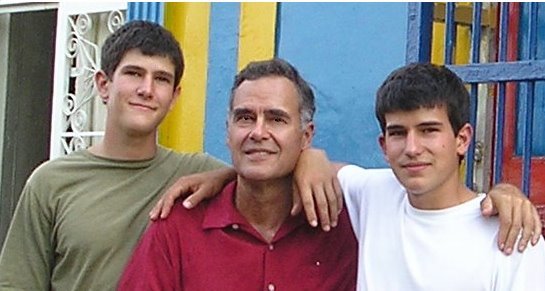
Another son, Jan Brouwer, came to visit with my wife Susan, and decided he would stay until June. He’s working with his brother Ari at Las Lajitas organic farm, part of La Alianza Cooperativa. (Susan had to return to her teaching job in the States.) The boys rise at 5:20 am, join Omar, one of the long-time members, at 5:45, and start ascending the mountainside. Work begins in earnest at 6:30, with breakfast around 8:30, and lunch about 1:30. At 2:00 pm they’re hoofing it down the steep mountain road with plenty of time left to enjoy the day. Since they’re new to farm work, they often head straight for a short siesta.

One of our favorite pastimes is hiking in the “quebradas,” the deep ravines that carve their way into the mountainsides. This waterfall and pool, called “Charco del burro,” are about fifteen minutes below our house, a good place for cool shower after work on the afternoons when the water isn’t running in Monte Carmelo.

Charco del Burro, according to local legend, is haunted by the soul of a donkey who fell into the pool and drowned a hundred years ago.

Upstream from the waterfall is the “angostura,” the narrowest part of the gorge.

Although this land is green, beautiful, and cultivated by hard-working campesinos, it was until recently very poor. Since the early years of the Chavez government, living standards have been rising steadily as fair prices for vegetables and coffee have stabilized or been guaranteed by the government. Many small farmers and cooperatives have taken advantage of loans and grants to introduce new kinds of productive and environmentally-friendly farming methods.

Non-monetary gains, such as the variety of educational, nutritional, recreational, and health missions that are now available to almost everyone, have also contributed immensely to improving the quality of life. Our village of Monte Carmelo now has a paved street, three bodegas, food stands selling empanadas and hot dogs (a Venezuelan perrito caliente, with a about 20 different toppings thrown on at once, bears little resemblance to its U.S. counterpart), a lighted futbalito and basketball court, and a tiny high school for the one hundred and thirty families that live with a kilometer of the little plaza. It also has an ambulatorio, a walk-in medical office served by a Cuban doctor who has just returned after getting more training in Cuba with a six-month course.

We could throw out a number of impressive statistics to go with the list above, but one small number is probably the most astonishing: 8. There are now eight young people from Monte Carmelo, population less than a thousand, enrolled in the first three years of the six year Medicina Integral Comunitaria program (see other two articles.)

There are forty other students studying medicine in this rural municipality, Andres Eloy Blanco, which has a little over 50,000 inhabitants. Many of them live in Sanare, the capital of the municipality located about 7 kilometers, or fifteen minutes, away from Monte Carmelo.
Looking down toward the valley from mountain and the Las Lajitas farm. Sanare, population 25,000, lies in the distance and serves as the hub of this agricultural area that produces as much as 30% of all the coffee in Venezuela.

Friday, January 18, 2008

Will the press, owned by the oligarchy, be able to undermine the popular revolution? (And, are they getting a little help from the CIA?)

“... private capitalists inevitably control, directly or indirectly, the main sources of information (press, radio, education). It is thus extremely difficult and in most cases quite impossible, for the individual citizen to come to objective conclusions.”
– Albert Einstein,“Why Socialism,” Monthly Review, 1949


In the national and international press, President Hugo Chavez and his government of Venezuela are often accused of dictatorial tendencies even though there is little evidence to support that contention. Anyone who stays here for a considerable period of time will realize that this is one of the most open countries in the world, characterized by a friendly and outspoken population that isn’t hampered by rules and regulations, and by a press that is free to say anything it wants. Aside from the riches generated by the state-owned oil industry, the nation has a thriving economy with millions of small business people and a powerful capitalist sector that asserts oligarchic control over almost all other big business enterprises, including the press.

Most analysts here and abroad estimate that 90-95% of the newspapers in Venezuela support the opposition and are published by wealthy members of the oligarchy. Their papers and the types of information, or disinformation, that they circulate present a major challenge to the government and the two-thirds of the people that support Chavez. These media are located in every major city and are responsible for generating the usual staples required of regional papers: stories on local affairs, sports, business, culture, want ads, etc. Thus they reach an audience far greater than their opposition supporters, including many people who may dislike the anti-Chavista editorial line, but want access to local news and advertisements. This allows the papers to generate confusion by planting outrageous sentiments, some of them disguised as news.

Extreme examples of the outrageous were seen during the recent vote for constitutional reforms in December, when the opposition used their media tools to bombard the population with arguments against the reforms, and advertisers were free to say anything they wanted, even in the few major papers that maintain a stance of neutrality toward the government. For instance, the Cámara Industrial de Carabobo, an organization of industries which includes many subsidiaries of U.S. multinational companies, posted a giant two page ad in Ultimas Noticias, an even-handed paper with the largest circulation in the country. The industrialists told parents that the reforms would allow Chavez to steal their property and their children. The ad read, in part:

If you are a Mother, YOU LOSE! Because you will lose your house, your family and your children. Children will belong to the state.

To William Blum, U.S. expert on the CIA and its efforts to destabilize other countries, this sounded very much like efforts that were mounted against Salvador Allende in Chile in the 1960s and 1970s. Recently Blum described them in his Anti-Empire Report:
…one radio spot featured the sound of a machine gun, followed by a woman's cry: "They have killed my child -- the communists." The announcer then added in impassioned tones: "Communism offers only blood and pain. For this not to happen in Chile, we must elect Eduardo Frei president." Frei was the candidate of the Christian Democratic Party, the majority of whose campaign costs were underwritten by the CIA according to the US Senate. One anti-Allende campaign poster which appeared in the thousands showed children with a hammer and sickle stamped on their foreheads.

William Blum and I both spoke to audiences at the Book Fair in Caracas in November about what´s happening in the heart of the Empire (otherwise known as the United States.) Blum was also invited to appear on Venezuelan television because he has a special kind of expertise. He has written some of the most valuable books that you can find on the destabilizing and murderous activities of the CIA and the U.S. State Department, including Killing Hope, Rogue State, and Freeing the World. Blum once was employed by the U.S. State Department himself, but quit in disgust over the kinds of things he saw done in the name of U.S. democracy. Since the 1970s he has devoted himself to researching and writing about the foreign interventions that most U.S. citizens choose to ignore. Recently, in his e-mail newsletter, “The Anti-Empire Report,” he gave a brief review of the record since World War II:

Attempted to overthrow more than 50 foreign governments, most of which were democratically-elected; successful a majority of the time.

Grossly interfered in democratic elections in at least 30 countries.
Attempted to assassinate more than 50 foreign leaders.

Dropped bombs on the people of some 30 countries.

Helped to suppress dozens of populist/nationalist movements.
(In sequence, details of the five items can be found in Blum's books: "Freeing the World", chapter 15; "Rogue State", chapters 18, 3, 11, 17; see also "Killing Hope" for further details)

The Venezuelan press continues to serve daily doses of propaganda – who is producing it?

The anti-Chavez propaganda attacks continue to appear regularly in the Venezuelan media, which are allowed, and rightfully so, to express these opinions on their editorial pages. The commentators’ rhetoric is overblown and seldom accompanied by rational arguments or a careful exposition of the faults of the government.

The problem is that this kind of heavy-handed indoctrination has spread throughout the news sections of the papers. Last week I perused one of the two major newspapers, both backing the opposition, that are published in Barquisimeto, the city of one million that is the capital of the State of Lara. I wasn’t looking for the worst, since I bought El Informador, the more moderate of the two papers; it allows an occasional pro-Chavez editorial to appear alongside the conservative columnists on its opinion page.

On pages A3 and A4 of El Informador, in the regular news section, I found various articles prepared by news organizations without attribution to individual writers. One of them had a particularly inflammatory headline:

El plan fue diseñado en conjunto con Fidel Castro
Desabastecimiento forma parte de un plan estratégico de Chávez
Intopress, Caracas, febrero 7

The plan was designed with the help of Fidel Castro
Food shortages form part of Chavez’s strategy

This entire article was devoted to repeating, without any analysis or response from other sources, a diatribe circulated by Johnson Delgado, president of the COPEI party in the state of Tachira the previous day. Delgado claimed that the food shortages experienced in some stores in the country were planned by Chavez in conjunction with Fidel Castro in order to create so much chaos and unhappiness among the populace that the government could declare martial law and impose a dictatorship on the Venezuelan people. (The COPEI party, by the way, was once a major party, but was discredited by corruption years ago and has only received a tiny fraction of the national vote in the past decade.)

[By the way, food shortages of particular items, such as powdered milk, are real, and a nagging problem right now. But this should not be confused with a lack of food in general, since Venezuelans, particularly the lower classes, are consuming a lot more food than ever before due to vastly increased wages, low cost markets at Mercal, and a variety of government nutrition programs. And the supermarkets in middle class areas are overflowing with food, just like in the U.S. One factor that is getting no attention from the opposition, and possibly not enough attention from the government, is the huge jump in prices of basic food commodities on the world market.]

This article devoted to Johnson Delgado was generated by a news agency named Intopress that seems to specialize in anti-Chavez articles lacking any factual content. Three other pieces on the page were more conventional reporting concern regional elections, the resignation of a Supreme Court judge, and a debate over hoarding food in the National Assembly. A fifth article, supplied by a news agency called AMM, was similar in tone to the article from Intopress, and also read like an opposition opinion piece – it simply quoted at length the rather wild opinions of Jorge Montoya, a leader in the Un Nuevo Tiempo opposition party, who ranted about Chavez’s ego, and the “fact” that Venezuelan ports are now “the principal points of departure for drugs in the whole world.” There was, of course, no evidence at all presented to back up this assertion.

Another similar article on the previous page was generated by AMM was devoted to quotations from Manuel Rosales, the losing presidential candidate in 2006 (63% to 37%) and governor of the state of Zulia. He claimed that the current national “government is dedicated to the destruction of the country’s economy and values.” Since real economic growth in Venezuela, after subtracting for inflation, has been 8% to 9% per year for several years (the highest in Latin America), it would have been nice if Rosales, or perhaps a reporter, had produced some numbers in support of his argument.

The media strategy is reminiscent of Chile in the 1970s, when the CIA was not content merely with financing anti-Allende political campaigns. It also worked hand in hand with the private media in Chile and flooded the newspapers and radio with negative stories about President Allende’s government and the government. Not only that, but other funds from the CIA were used to create negative events, as when it paid for a massive trucking shutdown by the owners of the transport industry, thus creating shortages of foods and other necessities among the general population.

Can we prove that the CIA or other U.S. organizations are directly manipulating and financing the press in Venezuela? No. But past history, and the direct help the U.S. is giving to the political opposition in Venezuela, suggest that they have some role in the current disinformation campaign being waged against the Bolivarian Revolution.

What should the Chavez government do in response?

Venezuela’s borders are open; its commerce with the rest of the world, especially the United States, is extensive; and there is complete freedom to travel within the country. Thus there are innumerable ways that money and agents from abroad could be at work generating disinformation that is harmful to the government and the populace in general. [There is even the possibility that the hoarding of food by some wholesale food businesses who hope to reap extra profits by forcing prices higher - a practice that has been documented by government raids on a limited number of warehouses - is also being encouraged by economic saboteurs.] The Venezuelan government is not being paranoid to suspect that the CIA and the U.S. State Department, and perhaps, some new “private contractors” are active behind the scenes.

The question for the government is: How to combat this pernicious influence?
One way of dealing with abuses in the press and other media, of course, is to follow the money. The National Assembly is currently putting pressure on the most notorious of the TV broadcasters, Globovision, to open its financial books and demonstrate the true sources of its funds. This may be helpful, but since many of the media-owning members of the oligarchy have substantial business holdings outside of Venezuela, it may be very difficult to show where personal finances end and contributions from foreign “friends” begin.

Another, more positive approach, was talked about last week at a national meeting of the PSUV (United Socialist Party of Venezuela) that was held in the State of Bolivar. In order to counteract opposition/imperialist propaganda, the PSUV activists talked about creating competing news outlets at the state and local levels throughout Venezuela. This probably a very good idea, but – how can it be achieved? And how long will it take?

Perhaps we can talk about the possibilities in a later post.


And now, a brief flashback to another time and another country, where the freedom of information is much more endangered by the corporate oligarchy.

An excerpt from Chapter 15 of my book, Robbing Us Blind: the Return of the Bush Gang and the Mugging of America, Common Courage Press, 2004

Murdocracy in America

John Ellis is George W. Bush’s first cousin and his very close friend since childhood. He was hired by Fox News to be a head honcho on their “Decision Desk,” sitting at the center of election night coverage in November 2000. During the broadcast he periodically took a break from his desk and telephoned George W and Jeb Bush about the progress of the vote counting. He made his fifth call at 2 a.m. and told his cousins,
“Our projection shows that it is statistically impossible for Gore to win Florida.”

He then returned to his desk and made “The Decision” at 2:16 a.m. He called the election for his cousin. Ellis later bragged to a reporter, Jane Mayer of The New Yorker, “It was just the three of us guys handing the phone back and forth – me with the numbers, one of them a governor, the other the president-elect. Now, that was cool.”

John Ellis was the first television announcer to declare George W. Bush the winner of the presidency. Then all the other networks followed suit. Even though the victory declarations at Fox and every other network were later rescinded, many television viewers were left with the impression that having a recount in Florida was unfair to Bush. How could the vote be determined to be too close to call? Hadn’t Bush already been declared “Winner in Florida?”

Some time later Ellis admitted, "I am loyal to my cousin.... I put that loyalty ahead of my loyalty to anyone else."

This explains why John Ellis called the election for the Bush Gang. But the real question is: Why was Fox able to install Ellis as the man in charge of election night reporting – manning the main desk just like Dan Rather at CBS – without revealing to the public that he was the cousin and very close friend of one of the candidates? John Ellis had not been signed on to give occasional right-wing opinions, nor to give political commentary as a family friend – in short, he was hired to report the news. Why didn’t the other news media scream to high heaven before, during, and after the Election night broadcasts? And who placed Ellis in that position on TV and how could they get away with it?

The puzzle fits together quickly. Ellis had been hired on a 30-day contract and worked for Roger Ailes, the director of Fox News and Republican media genius who brought Richard Nixon back into politics in 1968. Ailes was responsible for revving up the campaign of George Bush I in 1988, and later produced the Rush Limbaugh radio show for a while. Ailes was at Fox News because Rupert Murdoch, the Australian-born, multi-billionaire media baron, asked him to run the network.

Fox News is but one part of Murdoch’s world-wide empire, which began when he inherited his father’s newspapers in Australia. There he controls more than 60 percent of the country's metro, regional, and suburban press, which range from a sophisticated national paper, The Australian, to mass-market daily tabloids. The pattern of Murdoch’s scheme for global conquest under the flag of the News Limited, or the News Corporation, became apparent when he went to Great Britain. In the 1970s and ‘80s he accumulated 40% of the English newspaper readership. According to Russ Baker of the Columbia School of Journalism, “During the regimes of Prime Ministers Margaret Thatcher and John Major in Britain, Murdoch ventures -- especially his purchase of newspapers and the launch of his BskyB service -- were repeatedly favored with easing of regulations and with government failure to invoke monopoly oversight. Murdoch's papers, in turn, played a central role in bolstering Thatcher's career and virulently attacked her opponents.”

Murdoch finished circumnavigating the English-speaking world by landing in the United States, where he later assumed American citizenship. He took over print media such as HarperCollins publishers, TV Guide, The New York Post, and The Weekly Standard, as well as 20th Century Fox films. Most of his money and energy, however, went into buying and expanding his American and international TV holdings.

Murdoch has corporate subsidiaries in over 50 countries, but his primary interest has been in dominating the press, TV, and politics of the Anglo-American world. His political preferences are right-wing, even ultra-right, but he does not let politics interfere with his business expansion plans. Murdoch "is far more right-wing than is generally thought," according to Andrew Neil, who used to edit Murdoch's London Sunday Times. "In the 1988 American presidential election his favorite for the Republican nomination was Pat Robertson," Neil wrote in his book Full Disclosure. "Dole is far too moderate a conservative for his tastes."

While Murdoch was living in Britain, he was the major backer of Margaret Thatcher’s Conservative government, and then gave her a $5.4 million book contract when she left office. Once settled in the U.S., Murdoch became one of the biggest contributors to the Republican party, giving them about $1 million in 1996. The year before, while he was trying to get Congress to deregulate media laws that restricted his business expansion, he needed the help of Republican House speaker Newt Gingrich. He offered Gingrich a $4.5 million advance for his book, To Renew America. The Speaker was ready to accept, but the House Ethics Committee forced him to give up the contract because it was such a blatant conflict of interest.

Rupert Murdoch is not averse to political flexibility, however, when it serves his business interests. His newspapers have tended to be quite tolerant of China, sometimes publishing very favorable articles, especially at those times when his companies were negotiating for major access to the Chinese television market, the largest in the world. To sweeten the deals, he arranged for HarperCollins, his big publishing house, to print a book by Deng "Maomao" Rong, the daughter of the Chinese leader Deng Xiaoping. The advance, for a volume The New Yorker called "a turgid, barely literate piece of propaganda," was rumored to be $1 million.

Murdoch has also sided with Labor Party governments in Australia and Britain when he thought he could push them rightward on a range of issues. This was the case with Tony Blair, who traveled to Australia to confer with Murdoch and gain his favor before his first election as Prime Minister. The rightward shift of liberals and labor parties has suited two of Murdoch’s business objectives, namely to ease controls over monopoly ownership and to lower corporate taxes. Murdoch’s giant umbrella corporation, the News Corporation, has been a real pioneer in international tax evasion and the invention of new tax havens. It has woven a web of more than 800 subsidiaries which continually transfers profits from different operations in different countries until they find the safest – that is, tax free or nearly tax free – home. The Economist reported in 1999 that “The most profitable of News Corporation's British operations in the 1990s was ... News Publishers, a company incorporated in Bermuda. News Publishers has, in the seven years to June 30th 1996, made around £1.6 billion in net profits. This is a remarkable feat for a company that seems not to have any employees, nor any obvious source of income from outside Mr. Murdoch's companies.”

While the Bermuda angle is great scam for Murdoch, just as it is for U.S. multinational firms, there was a better place for Murdoch to set up shop. As far as the interests of the News Corporation are concerned, it had to be a country where rampant deregulation and a favorable tax atmosphere allowed corporations to overwhelm democracy in a big way. Murdoch decided that the United States fit the bill, especially once the first Bush Gang let the deregulators loose and opened up the country for merger mania in the 1980s.

-----------------------------------------------------
Something else to consider: Rupert Murdoch now owns The Wall Street Journal.

Tuesday, December 11, 2007

Reflecting on the Reform Vote

Friday, November 30, the Avenida Bolivar

It was late in the afternoon, the sun was about to set, and President Chavez was addressing the huge crowd that stretched up the Avenida Bolivar in Caracas. I had just waded through this sea of red, pushing through the tightly packed, happy crowd that extended down side streets and into neighboring parks. It was estimated that at least 500,000 people showed up, including 15 of us from Monte Carmelo and about 50 other people from nearby Sanare. We had left the State of Lara on two buses at 10 p.m. the previous night and arrived in Caracas early Friday morning. The fiesta atmosphere and the enthusiasm of the huge crowd made us think that the constitutional reforms would surely be passed in the election on December 2nd.

Even the dogs were reds, and they were celebrating.

Why is there no photo here showing that the Avenida Bolivar was also filled with people on the previous day, November 29?

Because we weren’t there and the government was trying to ignore the protest. The political opposition was able to assemble a very large crowd in the same place the Chavez supporters would be the next day. They did not bring out 500,000, but quite possibly 200,000 or more, an impressive number for an opposition that had been divided and ineffectual for a long time.

Shortly before I took my photo on November 30 of the pro-Chavez, pro-reform gathering, I bumped into a friend in the crowd who happens to live in an apartment high above the Avenida Bolivar. He told me that from his vantage point he could see that the opposition had filled the avenue the previous day. He wasn’t pleased to see the sizable crowd, since he has worked very hard for several years on behalf of the Bolivarian Revolution. But he also wasn’t happy that the Venezuelan government television stations chose not to show the kinds of expansive panoramic views that would reveal the size of the march marshalled by their opponents.

On the other hand, long-range photos of the opposition march were given a prominent place in The New York Times and other media sources outside and inside of Venezuela, since they regularly play up events critical of Chavez and tend to ignore the Bolivarian Process itself. But this doesn’t mean that the government television and news outlets should do the same thing on behalf of their side. I’m not suggesting that neutral coverage was possible, but I think the Venezuelan people, and especially those who supported the constitutional reforms, needed to know more about the depth and strength of the opposition forces.

Possibly, if the Chavistas were armed with this information, they would have been able to prevail upon their neighbors - especially Chavez supporters in the barrios who abstained from voting in large numbers - to vote “Si” at the polls. Furthermore, the incident illuminates the need for more criticism within the Chavista movement, whose ‘to the barricades’ attitude about the revolutionary process often keeps them from engaging in a thorough evaluation of where they are going.

While this embattled attitude is understandable, given the constant barrages of vitriol and misinformation coming from the private media outlets and the United States State Department, it is not helping the political process to mature. (See a very informative Spanish video about how foreign right-wing sources have been helping to manufacture the Venezuelan ´student movement´ at Chris Carlson´s Gringo in Venezuela website.)

Critical Support is Necessary
Within any political structure, it seems nearly inevitable that those who feel they have an overwhelming numerical advantage will try to use it to solidify their position and advance their goals quickly. Clearly, the Chavez government felt that, with an electoral victory of almost 2 to 1 in late 2006, it had sufficient power in 2007 to enact the Constitutional reforms necessary for proceeding toward socialism.

If the government had been correct in thinking that a 2 to 1 margin of victory was possible in December of 2007, then we would not be questioning its judgment – we who generally support the Bolivarian Process would still be celebrating in the streets and anticipating the first steps of putting the reforms into practice.

But given that the government lost a close 50/50 vote, and did not get the support of 3 million people who voted for Chavez a year earlier, it’s only right that people question the content of the reforms and the way they were presented to the Venezuelan people.

Wider discussion of the reforms and other issues
In our little corner of Venezuela, Monte Carmelo, 303 campesinos voted in the election on December 2, more or less the same number that had voted in December of 2006. This meant that abstentions were not a factor here, as 255 voted for the reforms and 46 against. Nine more people voted against Chavez in this election, not a very large defection to the opposition.

Local voters are not ignorant or uninformed people, for they had engaged in spirited discussion of the reforms, grumbled about too much complexity and vague language, and then continued their tradition of supporting Chavez. But in a discussion with various neighbors last night, I found that they were ready to press ahead and try to pass some version of the constitutional reforms sometime during the remaining five years of Chavez’s term. This time it will be an effort that begins at the grassroots, gets discussed at length, and is brought to a national vote by means of a petition signed by 15% of the voters nationwide.

Some people in Monte Carmelo think that all the reforms are useful, but that some of them ought to be simplified as part of new education campaign that will reach the 20% of voters who voted in 2006 but abstained this time. Others expressed the opinion that no more than twenty or thirty reforms, rather than sixty nine, should be presented. According to one person it was important to select only the constitutional articles that are key to restructuring the government for a democratic socialist future. Another had a more gradualist view, thinking that the number should be limited to those that would pass easily now, while waiting a few years to push the more controversial articles.

Who knows? Maybe the people of Monte Carmelo will produce their own list of reformed reforms.

Feliz Navidad!

Maybe you have forgotten to get a really good book for someone for Christmas. If you and your loved ones want to know something about Venezuela, you should read two books that were published this year. One, Cowboy in Caracas, is a short and very accessible book about everyday life in Venezuela written by our friend Charlie Hardy. Charlie came here from Wyoming twenty years ago as a Maryknoll priest and spent nearly ten years living in a cardboard shack alongside some of the poorest people in the city. Although no longer a priest, he is still in Caracas and still on the side of the poor. In his own special, good-humored way, Charlie lets you know why the majority of Venezuelans have chosen to support Chavez and the revolutionary process.


Then there’s Hugo!, seen here sitting in front of our house


Hugo is an excellent biography written by Bart Jones, who spent 8 years in Venezuela, most of the time as an Associated Press reporter. In September, the week after the book was published in the United States, I was the one designated to deliver the three hot-off-the-press copies to three of Bart’s closest friends in Venezuela. Of course, I made sure I read the book completely before giving up the last copy. I’ve been meaning to write a full book review ever since, because this is by far the most comprehensive and informative biography of President Chavez that I have found in either English or Spanish. (There are some opposition versions that are full of invective and misinformation, while a couple of fairly accurate books in Spanish suffer from a bit too much adulation.) Jones´s book is long, at over six hundred pages, every one of which is necessary to give the non-Venezuelan the historical background needed to understand both the Chavez phenomenon and the necessity of revolutionary change. Since Bart writes succinctly and gracefully, you should not find it difficult to keep turning the pages.

And don’t forget to keep checking online articles at Venezuela Analysis (http://www.venezuelanalysis.com/), the only comprehensive website in English that covers politics and social change in Venezuela. Greg Wilpert, who founded the website some years ago, also has a new book about the Bolivarian Process that is bound to enlighten you.

Counter-revolutionary students get attention from the global media,

but revolutionary changes are taking place at Mission Sucre, a different kind of higher education

In the third week of October, there was another protest against the Chavez government in Caracas by thousands of students who were opposed to the proposed Constitutional reforms that were voted on last week.

In spite of the fact that these protests were often led by young people with ties to extreme right-wing parties, which in turn have direct ties to the U.S. Embassy and the opposition media empires, most of these students were sincerely expressing their desire to stop the Bolivarian Process. And their free speech was being protected. In fact, at one of the protests that week, when some pro-Chavez supporters gathered opposite the anti-Chavez demonstrators, the two groups started throwing stones and bottles at each other. Metropolitan Police of Caracas took measures to shut down the counter-protest even though those demonstrators were voicing support for the government.

Still, those outside of Venezuela should be aware that the anti-Chavez, anti-reform movement did not involve a majority of university-level students. Numbers and percentages are hard to estimate, but it would be surprising if more than a third of all people taking advantage of higher education (the total is somewhere between 1,200,000 and 1,400,000) were campaigning and voting against the referendum. Of those 1,200,000 plus students, about half (more than 600,000 students) are studying in conventional universities. Most go to elite public universities that mostly serve the middle and upper classes, and about 170,000 go to expensive private schools that are home to many of the most conservative protesters.

But this is only part of the equation, because just as many Venezuelans are studying outside of the conventional universities in the Mission Sucre program. This allows them to work toward university degrees by attending classes at night or on weekends in whatever local building – grade school, high school, church or community center – has space for them and their professors. Five years ago there were no Mission Sucre students. Today they make up half of the total number of people who are advancing themselves through higher education.

This huge explosion in education is transforming Venezuelan society. The new constitutional reforms were designed to promote more participation and equality of this kind, thus lessening the advantages of those with extensive family resources.

No wonder students at the elite institutions are worried about their futures.
Will their expensive private education be sufficient for finding employment?
Will they be displaced by students whom they perceive to be less qualified?
Will they be marginalized by those who used to be socially marginalized?


Luis, Ayleen, and Cirilo in the matching shirts they bought for the public presentation of their thesis.

Mission Sucre
I first encountered Mission Sucre when I was visiting a run-down, three-story high school in the barrio of Antímano in Caracas in late 2004. At five or six in the evening, as the high school students were wandering home, the school building was filling up with people who had been laboring all day.

There is an image that still sticks in my mind: men and women were racing down to basement storerooms, grabbing dozens of huge Chinese TV sets, the kinds with 50 inch screens, and muscling them up to third floor. They wanted to make sure the video teaching materials were all in place so that their professors, most of whom were donating their time after going to their regular jobs, could start classes at the appointed hour.

This past year I learned that a large numbers of adults in our rural area of Monte Carmelo and Sanare are enrolled in classes through Mission Sucre. Among them are those who have already completed their training to be teachers and taken jobs at local schools, and others who are beginning a long and rigorous six-year program in integral community medicine physicians (see the article on Fidel’s WMDs).

The same weekend in October that privileged students were protesting in Caracas, three friends of ours, Ayleen, Luis, and Cirilo, invited me to attend the presentation of their “thesis” at La Casa de Cultura (The House of Culture) in Sanare. This was a requirement for those graduating in Social Sciences with a technical degree, which is achieved after three years of study and is similar to the associate degree earned after two years of community college in the U.S. After completing this degree, the students can continue their schooling for another two years and qualify for their “licenciado,” the equivalent of a bachelor’s degree at a U.S. university.

There were six teams that presented group projects in Social Sciences in front of a panel of academic judges in a large hall filled with over 100 members of the public. All the teams had been assigned to analyze the situation of particular barrios (neighborhoods) in Sanare or small caserios (hamlets) in the countryside, and then help these localities develop and organize communal councils. I was pleasantly surprised to see one of my neighbors there. Carmen, who lives across the street from us, was part of a student team that was diagnosing problems in Monte Carmelo.

Each team had to give an oral presentation, complete with slides and maps of the communities, and a description of the methodology of their analysis and their working relationship with the communities. Then they shared their recommendations and conclusions with the audience. Some individuals in the audience were members of the communities that were studied, and they offered commentary on the value of the research done by the students.

During the presentations, which averaged about 40 minutes each, it became obvious that I was watching a new model of education. The students had been asked to engage in practical work aimed at mobilizing people for one of the most important stages of the Bolivarian Revolution, the formation of “consejos comunales” or communal councils.

In the past year, the national government has encouraged a new kind of grass-roots direct democracy that is designed to bypass old inefficiencies and corruption at the state and municipal levels and deliver control to the people themselves. Neighborhood groups of families, up to 400 families in the cities, and up to 200 families in rural areas, are authorized to form communal councils which will decide and administer local affairs. They are entitled to receive government funds directly, give out loans and grants, and embark on the projects that they feel are most important for their communities.

Tens of thousands of the communal councils are already up and running all over Venezuela. In Monte Carmelo, at a May meeting I attended, fifty-one out of 125 families in the vicinity of the village were represented. Almost everyone present engaged in a lively dialogue as they outlined tasks for the months ahead and authorized funds for rebuilding a house for an old man who had been devastated by illness.

Some communities, however, are poorly organized and apathetic, and have been slow in forming councils. For this reason, five of the student groups decided that their major research commitments would revolve around working with these communities.

Our neighbor Carmen and her group chose a different kind of project than the other groups, since they chose to work in a community, Monte Carmelo, that was already highly organized. Their challenge was to collect more information about a problem that had already been identified by activists and organic farmers: the serious medical dangers posed by the overuse of
pesticides.Our neighbor, Carmen (center), and two women from the neighboring village of Bojo presented their thesis on ecological research and education related to the use of pesticides in Monte Carmelo.

Years ago the cooperative farmers at La Alianza [see related article] noticed that they were poisoning themselves and their families and started farming organically. Some of their fellow farmers took notice and sharply diminished their pesticide use, too, but many others continued to believe that only heavy spraying would produce high yields from their cash crops. They still tramp through the fields of Monte Carmelo with spray cans strapped to their backs, and the wind scatters the residues over neighboring houses. The group’s task was multi-faceted, since it involved gathering and disseminating more medical information, as well as extensive interviewing to evaluate the opinions, awareness, and knowledge of the inhabitants.

Some of the other groups had a more elementary problem: How would they get people to attend meetings and identify local problems that they could address through a community council? Luis, Ayleen, and Cirilo went to Las Virtudes, a hamlet located more than an hour outside of Sanare. The village sits amid one of the most important coffee-growing areas in all of Venezuela, but has extremely high levels of poverty and a dearth of social services and educational facilities.
The team described the challenges involved in drawing people into meetings and promoting collective action, with special attention given to organizing energy groups (Mesas de Energia y Gas) that will ensure that everyone in the area has access to electrical energy for lights and gas (propane) for cooking. The three also told the audience about the ways they collected demographic information and historical material about Las Virtudes and then shared it with the community. In an introduction that described the spirit motivating all the Sucre teams, they wrote that they were helping the community councils because “a new era is beginning in the revolutionary process and we have to confront some great challenges.”

Now the “consejo communal” and related committees are up and running in Las Virtudes, and the people are forming cooperatives and applying for government grants and loans. Cirilo, whose regular job is working as a manager in a new coffee export company, says his Mission Sucre experience won’t be ending now that he has a technical degree. “I plan to keep studying further, but it’s even more important that we follow through on our commitment to the people of Las Virtudes. Now we have an obligation to keep working with them and their “consejo communal.”

The Bolivarian Process is urging students to share knowledge with their fellow citizens in a way that is virtually unknown at the traditional universities. Students at the elite universities are not asked to make a social commitment as part of their studies. Most likely they probably aren’t aware of the valuable work that Mission Sucre students like Ayleen, Luis, Cirilo, and Carmen are doing in their communities. This only underscores the kinds of division – by educational institution, by political persuasion, and by social class – that are causing turmoil in Venezuela today.

(Note: Minister of Finance Rodrigo Cabezas recently presented the national fiscal budget for 2008 to the Venezuelan National Assembly. He stressed that Venezuela is spending a much greater percentage of its budget on education than any other country in Latin America. For 2008, nearly 22 percent of the national budget will be directed toward primary and secondary level education, compared to 9 percent in 1998. This includes an increase in the funding of the social missions of the Chavez government, which will receive a total of Bs. 5.5 trillion (US$ 2.5 billion), an increase of nearly 62 percent from the 2007 level. These social missions include the national health program Barrio Adentro and the literacy and education programs Robinson, Rivas, Che, and Sucre, among many others. )

Wednesday, December 5, 2007

December 2nd, Election Day in Monte Carmelo

Unfortunately, horse can´t vote.

There was a cloud sitting on the mountain at 7 a.m., and the first voters made their way through the fog on foot, on motorcycles, or on horseback. One of the first in line was Diluvín, who’s the maestro of welding steel and playing the violin in Monte Carmelo, and also the man who looks after the complicated old pipeline that brings water down from the mountain forests. The neighbors say he’s a genius because he can figure out how to make anything. He was ready to cast his vote for the “Si!”

Around 10 a.m. the sun was shining brightly and people who had already voted were sitting on the wall next to the polling place which was located in the elementary school. The voters were chatting with each other and happy to share a few thoughts about the vote and the constitutional reforms. Yocelin Gonzalez said, “My opinion is that we should support the reforms because this is the way that we can assure a brighter future for our children. So I say: Si! Si! Si!”

Isidro Garcia, a retired farmer I had talked to the week before, had a message for people in the United States. “This guy Bush should not be meddling in Venezuela,” he said, “he should be helping all the poor people in his own country. Venezuelan people aren’t against the North Americans or the United States. We just want to be able to pursue our own political course.”

As Isidro was talking to me, a member of the Army Reserve came over and asked us, very politely, to move about thirty feet away from the gate to the school where people were waiting in line to vote. He didn’t want our conversation to influence people who had not voted yet. There was absolutely no election propaganda - no signs, buttons, or cards - anywhere in the village suggesting how people should vote. And the voting system is a dream: one kind of electronic voting machine is used all over the country and it is able to print out paper copies of each completed ballot (which are then deposited in boxes for recounts, if necessary). Just think, if we in the United States had had such an efficient and fraud-proof system, then Bush would not be our President.

At 11 a.m. Boni Gomez, a school administrator from Sanare and a local coordinator on behalf of the “Si!” vote, drove up the mountain in his little red car and informed us that about 35% of the electorate had already turned out to nationwide. They were hoping for at least a 50% turnout, he said. (But 50% of whom? I wondered.)

After lunch I listened to our neighbor, Abigail, who had worked as one of the local election officials for the past four elections, but was happy to be replaced by others this year. The committee had started setting up tables, etc. in the polling place at 5 a.m. and would not leave the school until after 8 p.m. She explained that “the election is very important because the reforms will provide the laws that can advance the peaceful socialist revolution that the president is leading. This is a key moment if we are going to be able to replace the strong capitalist influences that are preventing socialist measures from being implemented.

“Of course, the richest people are opposed to the reforms because their power will be limited in the future. That’s why they have frightened some of the poor people with their propaganda, saying that the government wants to seize their land. I know one man who believes that his tiny parcel of land is in danger, so now he just went and voted “No.” He did this even though he just received a low-interest loan from Fundafe, a government agency, so he could make improvements to his land.”

Around four p.m. I joined Carmen, her granddaughter Paola, and some other people who were sitting in the sun in the plaza in front of the church. “First,” said Carmen, “I want to send a greeting to the people of the United States from the people of Venezuela. Once again we’re demonstrating how to fortify the democratic process in a very civil and peaceful manner. All of our ten elections since 1998 have been very responsible and aboveboard.”

Just then, Pepi walked up, gave Carmen a big hug, and said, “We’re always voting on opposite sides but we still love each other.” “See,” replied Carmen as she turned to me, “we can live together in friendship even though some of us are with the Bolivarian Process and some are against it.”
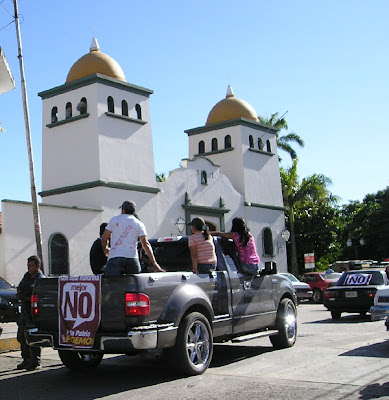
Some of the other old-timers, like Joel, Pascual, and Miguelito, have strong loyalties to Adeco, or Acción Democratica, the old Social Democratic party that was a major force in Venezuela and local politics for many decades, but now has only a tiny following. All of them were in danger of going blind from cataracts and other eye maladies that are common here, so they were flown to Cuba by “Misión Milagro” (the Miracle Mission) for eye surgery. Now, they’re happy to have their eyesight restored, but that doesn’t mean they are about to abandon their political loyalties – there’s no way will they ever vote for Chavez.

Diluvín, who had been one of the first to vote, joined the conversation around 5 p.m. as the polls were closing because nobody was waiting in line. By 5:30 the sun was getting low in the West and the air was getting chilly, so most people retreated to the warmth of their houses, and Diluvín and I were left alone. “I wish more of the other campesinos could read better,” he confided, “then they would know how many things in this new constitution are going to benefit them. There were an awful lot of Articles to read through in the reforms. I’m afraid that some of them didn’t bother to vote.”

Monte Carmelo votes overwhelmingly for “Si!” The nation votes “No!”

As it turned out, Diluvín did not need to worry about his fellow campesinos, at least those around Monte Carmelo. By 8 p.m. we knew that three hundred and three citizens had turned out to vote and they supported the Reforms overwhelmingly, 255 to 46. In neighboring Bojó, the response was similar, 225 to 34.

But elsewhere, in other hamlets and in the poorer barrios of the town of Sanare (the county seat has about 25,000 inhabitants), there was a high degree of abstention, at least compared to the presidential election of December 2006. This time the nationwide participation rate was 56%, very high compared to off-year elections in the United States (when there is no presidential election and somewhere between 30% and 40% of the people vote), but low compared to the 75% who voted last year in Venezuela.

Around 8 p.m. we also learned that in Sanare, where about 70% of the voters chose Chavez in 2006, a majority of the voters voted narrowly for “No” on the constitutional reforms. This turned out to be a reliable indicator of national sentiment, but we had to spend hours waiting for the first bulletin of electoral results. It was clear to us the tally was going to be very close or they would have made an announcement earlier. Around 11 p.m. I said goodnight to some friends and their TV set, returned to our little house and fell asleep.

I kept sleeping, not knowing that at 1:15 a.m. they announced that the “No” vote had triumphed. According to my neighbors who stayed up, President Chavez handled the news graciously. He appeared on TV and acknowledged that the result was fair and, even though his proposed reforms had been defeated, this was the way that a democracy was supposed to function.

At 6:30 a.m. on Monday I wandered into the house next door to get our yogurt (we use their refrigerator since we don’t have one), and Abigail told me the news: “We lost. The “No” won.”

The she added, “Perdimos la batalla, pero vamos a ganar la guerra.” (‘We lost the battle, but we’re going to win the war’ – a line that would be repeated several times by the residents of Monte Carmelo on Monday.) She kept patting the arepas, the fat tortillas that she was making for breakfast, and added calmly, but with determination,“We just have to keep working and the revolution will go forward.”

I woke my son Ari up at 7, told him the bad news, and then the good news: “Abigail says its time to go to work.” Not political work, but harvesting work. From 7 to 10 we helped Abigail, Gabriel, and their family pick coffee from the trees that grow directly in front of our two houses, and then, from 10 to 12, we picked and husked corn in the large garden area on the west side of their house.
Life goes on, a campesina’s work is never done.

By afternoon the physical labor had cleared up my foggy brain cells, and I was ready to digest some numbers that were delivered by Sandino, the twenty year-old activist who lives down the road. Sandino reported that the voter turnout nationwide on Sunday had fallen by three million people compared to the number of voters who participated in the presidential election of 2006. This was, more or less, the margin of victory that Chavez had enjoyed in that election. It appeared that the referendum on the constitutional reforms had failed because so many Chavista supporters did not turn out to vote. Three million people abstained.

On Monday, the day after the election, some of the “No” supporters enjoyed a little parade around the main plaza in Sanare to celebrate their victory. Previously Sanare had given about 70% of its votes to Chavez.


How the vote went down

Although many committed Chavistas turned out to support the ¨si¨ vote in Sanare, many stayed home. Thus the opposition won in a town that voted 70% for Chavez in 2006.

The official results of the December 2nd vote on the Consitutional reforms, 50.7% “No,” 49.3% “Si.” 9 million people voted, the winning margin was 125,000 votes.

Last week I tried to give an informed, but quite speculative estimate of the percentage of Chavez supporters among the upper classes (rich and middle class) and the lower classes (poor and working class): 4% upper + 64% lower equaled a total of 68% who were supporters. As for Chavez opponents: 16% upper class + 16% lower class equaled 32% of opponents.

In a footnote, I suggested that since this was a rough estimate, and since many lower class people seem to be confused about the reforms, maybe we should consider a more conservative split. This was a good idea, and also a way of covering my ass given the over-optimistic appraisal of the pro-Chavez forces that I had offered. So now, let’s consider a 60/40 split, a nice round number that is probably more realistic.

60 % of the population is pro-Chavez, 40% is anti-Chavez, so how did the “No” vote win?

Even though Chavez won with a 63/37 majority (nearly two thirds) in 2006, a 60/40 split is very much in keeping with the average pro/anti sentiment in previous elections over the past nine years. Chavez won by three million votes in 2006 because 12 million people voted, 75% of the electorate, a much higher proportion than had ever voted before. (U.S. turnouts for presidential elections, by comparison, have been between 49% and 60% over the past few decades.)

This year because Chavez was not a candidate, and because the constitutional reforms were presented in a haphazard and confusing way (even the wording of some articles was incoherent), election turnout was much lower, 56%. (This has always been the case with referendum and off-year elections, as it is in the U.S., where 35% to 40% of the electorate turns out to vote for Congress people and Senators.) The anti-Chavez people were able to win this year because they turned out to vote at much greater rate than the pro-Chavez people.

Here is a what happened, more or less. About 45% of the Chavez supporters (60% of the population) turned out to vote, but many others did not because they were confused or weren’t sufficiently motivated, so that the reforms only got the backing of 27% of the total population. And 70% of the Chavez opponents (40% of the population) voted, because they were excited and well-organized for a change, meaning that 28% of the voting population wanted the reforms to be defeated.

Supporters 60% x 45% turnout = 27%, Opponents 40% x 70% turnout = 28%, making a total turnout of 55%.

This happens to be very close to the actual 2007 voter turnout of 55.9%, almost 20 points lower than the December 2006 voter participation rate of 75%. In the 2007 election in Venezuela, there was superior interest and commitment on the part of the upper classes, and they won. If the lower classes had participated at the same rate as in 2007, they would have had another 3 million votes. Would all of them supported the reforms? Probably not. But they still would have won handily.

Sounds like the U.S.A.

I have been arguing for years (see my books Sharing the Pie and Robbing Us Blind) that the United States continues to have such a conservative government because the Democratic Party is unwilling to build a popular base and a political program that supports the aspirations of the poor, working class, and lower middle-class people who make up the large majority of the U.S. population.

“Lower-income people, especially the third of the electorate with household incomes of under $30,000 a year, vote overwhelmingly Democratic. The upper twenty-five percent of households, who make over $70,000 a year, have always favored the Republicans. Voter turnout in presidential elections is about 35 percent of the former, versus 70 percent of the latter. If Democrats can get the lower half of the working class to register and vote, they will win handily. If they convince the upper half of the working class” [those earning between $30,000 and $70,000] “to vote for their own interests instead of the interests of the wealthy, they’ll win by an extraordinary margin.” (Robbing Us Blind, 2004, Chapter 18)

On the afternoon after the election, when I talked to Gaudy Garcia, a long-time campesina activist in Monte Carmelo, she was a bit sad and still tired. (She was one of those who had labored at the election tables for 15 hours on the previous day.) But she wasn’t about to stop working for El Proceso.

“What we’re lacking is ideological education,” Gaudy said. “Too many of the Chavistas are still unaware that there is a class war going on. If they don’t show up to fight, they’re going to lose. But don’t worry, we’ll keep fighting.”